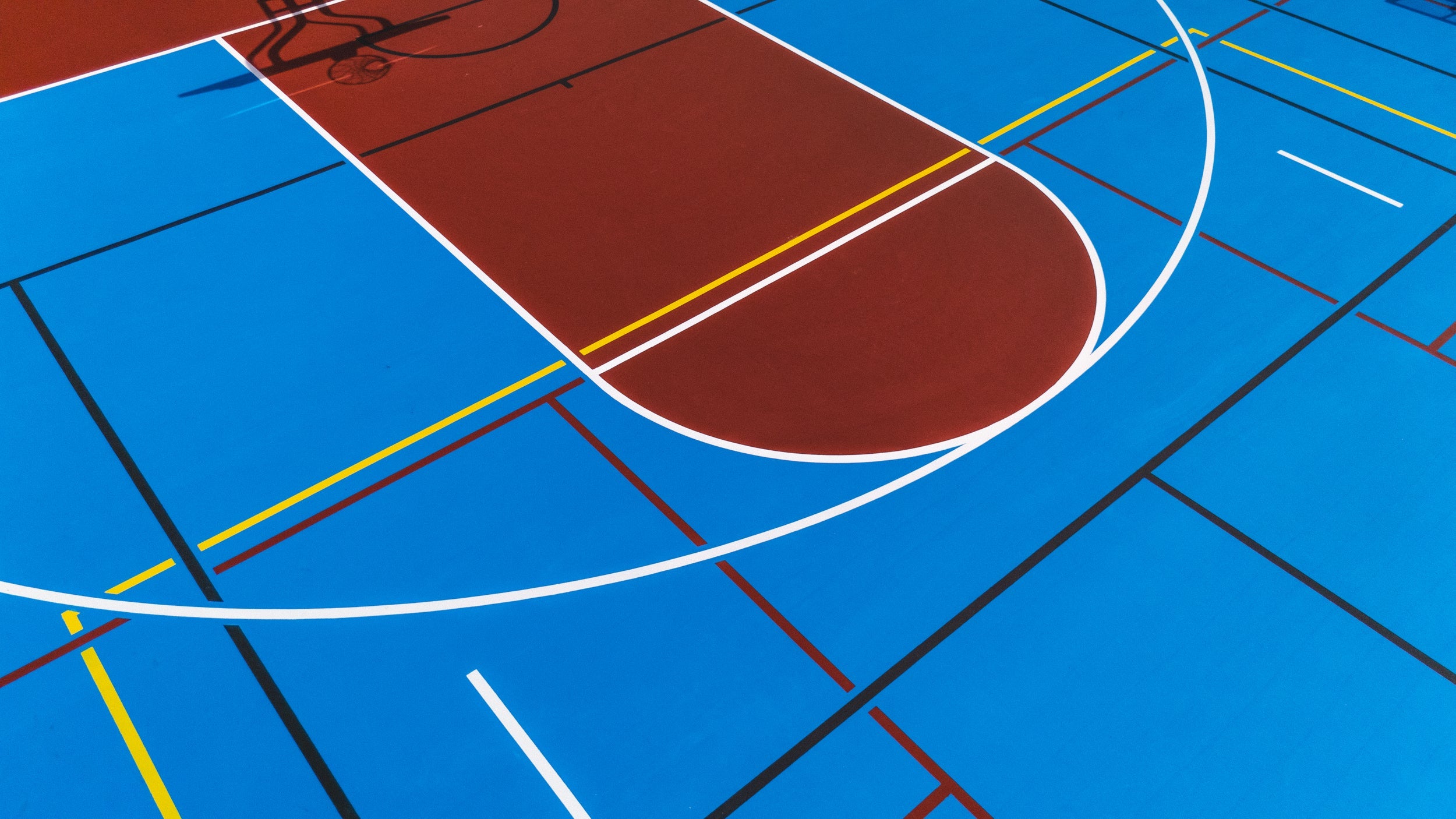
More homeowners, schools, and facilities are turning one court into several, painting tennis, pickleball, and basketball lines onto the same surface to get the most out of limited space. Done right, a multi-use court gives every player a clear, easy-to-follow layout no matter which game is being played.
The key to a successful multi-use court is planning the layout before any paint goes down. Each sport's lines need to overlap in a way that stays visually clear, with a consistent strategy for color, line weight, and placement so players never have to guess which lines belong to which game.
Let's take a closer look at how multi-use lines actually fit together, and what it takes to paint them cleanly.
Why Multi-Use Courts Have Become So Popular
Backyard space is limited, and not every property has room for multiple dedicated courts. Combining tennis, pickleball, and basketball lines on a single surface lets homeowners and facilities offer more ways to play without expanding the footprint.
This approach has grown alongside the pickleball boom in particular, since a full-size tennis court already has more than enough room to add one or more pickleball courts within its boundaries.
Whether you're building a new multi-use court or adding lines to an existing surface, having the right materials makes all the difference. DIY Court USA supplies Laykold acrylic surfacing systems, Laykold Textured Line Paint and Line Prime, and a full range of pickleball, tennis, and basketball equipment, giving homeowners and facilities everything needed to bring a multi-use layout to life.
Understanding How the Layouts Overlap
Before planning any paint job, it helps to understand how each sport's dimensions actually relate to one another.
Tennis court dimensions are the largest of the three, typically 78 feet long by 36 feet wide for doubles play. Because of its size, a tennis court is usually treated as the base layout that other sports are added into.
Pickleball court dimensions are much smaller, at 44 feet long by 20 feet wide, which means a single tennis court can typically fit two or more pickleball courts within its lines.
Basketball half-court dimensions vary depending on the level of play, but a standard backyard half-court typically needs roughly 50 feet by 42 feet, which is often placed on an adjacent section of pavement rather than layered directly into a tennis or pickleball layout.
Not every court size accommodates every combination, so it's worth measuring the available space carefully before committing to a final layout.
Keeping Lines Clear: Color and Line-Weight Strategy
Once you know which sports will share the space, the next challenge is making sure players can tell the layouts apart at a glance.
Most multi-use courts follow a simple approach:
-
The primary sport, usually the one played most often, gets white lines
-
Secondary sports use a contrasting color to stand out from the primary layout
-
Some courts also vary line weight or use dashed lines for a secondary sport to add another layer of distinction
Color and line-weight choices should be confirmed with your court surfacing provider, since not every line paint product comes in every color as a standard option.

Planning Your Layout Before You Paint
A clean multi-use court starts on paper, not with a paintbrush. Before any tape or paint touches the court, take time to:
-
Decide which sport will be the primary layout based on how the court will mostly be used
-
Map out the full-size dimensions for every sport that will share the space
-
Account for buffer space between overlapping lines so nothing feels cramped or unsafe
-
Plan the order of operations, painting the primary sport's lines first and layering in secondary lines afterward
Taking the time to plan the full layout in advance is the single biggest factor in avoiding a crowded or confusing court.
Materials You'll Need
Painting crisp, professional-looking lines depends on using the right products and the right process, including:
-
Masking tape to define each layout before painting
-
Laykold Line Prime, a clear-drying acrylic primer that fills minor voids between the tape and the court surface to reduce paint bleed
-
Laykold Textured White Line Paint, a 100% acrylic emulsion designed for tennis, pickleball, and basketball game lines
-
Basic measuring tools to keep every layout accurate
For the full step-by-step painting process, from applying primer to curing time, see our guide on How to Paint a Court: Tennis, Pickleball & Basketball.

Common Mistakes to Avoid
Even a well-planned multi-use court can run into trouble if a few key steps get skipped, including:
-
Skipping a full-scale layout or dry run before painting
-
Using the same color for every sport's lines
-
Forgetting to account for net post placement across multiple layouts
-
Painting without primer, which can lead to bleed and uneven, unprofessional-looking lines
Avoiding these mistakes early on saves time, paint, and frustration later.
Final Thoughts
So, how do you paint lines on a multi-use court?
The process starts well before the first coat of paint goes down. Understanding how tennis, pickleball, and basketball layouts relate to one another, choosing a clear color and line-weight strategy, and planning the full layout in advance are what separate a clean, easy-to-play multi-use court from a confusing one.
DIY Court USA offers professional-grade Laykold Textured Line Paint and Line Prime, acrylic surfacing systems, and pickleball, tennis, and basketball equipment to help homeowners, contractors, schools, parks, and recreation facilities build courts designed to perform for years to come.
Frequently Asked Questions
Can you fit a pickleball court and basketball court in the same backyard space? It depends on the available square footage. A standard tennis court typically has enough room for multiple pickleball courts, while a basketball half-court usually needs its own adjacent section of pavement rather than overlapping directly with a tennis or pickleball layout.
What color should secondary sport lines be? Many multi-use courts use white for the primary sport and a contrasting color for secondary sports to keep the layouts easy to tell apart. Available color options can vary by product, so it's worth confirming with your surfacing provider.
Do multi-use lines wear differently than single-sport lines? Lines that see more foot traffic or overlap with other layouts may show wear slightly faster than a single-sport court. Routine inspection and touch-ups help keep every layout crisp and visible.
Can you add a second sport's lines to an existing court later? Yes. Many court owners start with one sport's layout and add additional lines later, as long as there's enough surface space to accommodate the new dimensions without crowding the original layout.

Share:
Permanent vs. Portable Pickleball Nets: Which Should You Choose?
What Are the Dimensions for Pickleball Court Lines?